Welcome back for Part 4 in our series about nature journaling! Now we’ve talked about finding a space and adding writing to your practice. But today’s topic is one that is near and dear to my heart as a math/science teacher for nine years – NUMBERS!
Math in Nature Journaling?
Before we go much further, I want you to pause and think about the age-old question every student wondered about while sitting and learning about geometry, statistics, and algebra – When am I EVER going to use this? And while we might use some of those skills more often than others depending on our area of work, nature journaling does provide us the chance to stretch our mathematical muscles and practice. But how might we include numbers as part of a nature journal?
Count Me In!
One of the easiest ways to add numbers to your nature journal is to count something that you are observing – The number of birds… how many of a particular plant you can find… the possibilities are limitless! In fact, this can be a great on-going project for you to journal about when visiting your nature nook and allow you to track changes seasonally through the year. There are also ways to collect data like this as part of a group, like a the Great Backyard Bird Count each February.
Measured Approach
Another easy way to add numbers to your journal is to measure something that you are observing. You can estimate for objects that are difficult to capture details on (like a bird for example), but the more accurate, the better. This would require a tool, like the naturalist page from John Muir Laws or other tools, like:
1. Tape measure/Ruler – You can measure length, width, height, circumference, and more. I tend to prefer one that is flexible, though I sometimes carry a small business card sized one in the field.
2. Protractor – You can measure angles
3. Stopwatch/Clock – Measuring time can also be helpful -whether it is part of metadata or the amount of time a muskrat dives under the water, time can provide valuable information
Visualize It
There are several ways to show numbers and relationships visually.
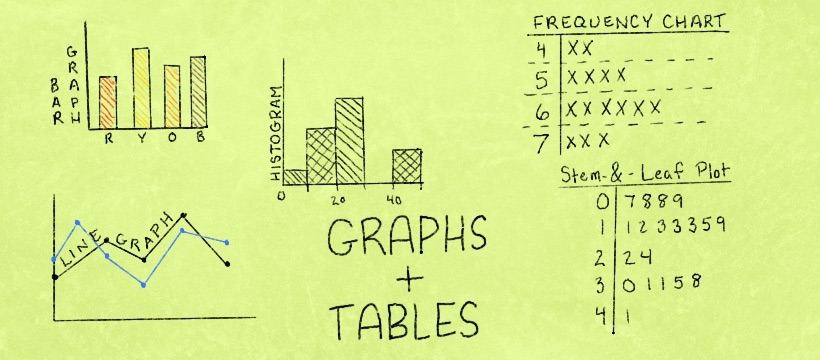
1. Table/Chart – a table or chart can be especially helpful if you are counting as part of your journaling. You can use tallies or write the total number depending on your style.
2. Graph – whether it is a bar graph (categories of data – like type of tree observed), histogram (frequency of ranges of numbers – like the heights of trees), or line graph (often change in something over time) or another form, graphs can help us see connections we might otherwise miss.
3. Stem-and-Leaf Plot – this is a form you may not have used since you were a student, but it can also help us see relationships within our data that might otherwise be missed.
Note that you can also add some fun details to tables and graphs with fonts, titles color, or pattern.
Citizen Scientist
If you are open to sharing your journaling with others, you can become part of the network of citizen scientists who share their data with others so everyone can learn from it. Data or information collected can be shared to platforms like eBird and iNaturalist for your fellow community members to learn from. You can also share your entry with fellow nature journalers.

Numbers, Now What?
Adding numbers adds some much needed detail to our work. Sometimes they are woven into the written parts of our entries, other times we might display them separately. Either way, when combined with words and pictures, they add helpful information for us and anyone we share it with. So next, let’s talk about the pictures and how they bring our journal entries together.
 Fernheart Designs
One thought on “Getting Started With Nature Journaling – Part 4: Beyond Measure (Numbers)”